Background
What Is Pure Copper? C10100, Purity and XRF Explained
Purity grades, C10100 and XRF — what you need to understand what real copper is.
Almost everyone selling copper bars writes "99.9% pure copper". But what does purity actually mean, why does it vary, and how do you know the number is true? This article explains copper purity from the ground up — so you can judge a copper bar on facts, not on a claim in a listing.
What is copper — and what is "pure" copper?
Copper is element number 29 (Cu), one of the few metals humans have used for over 10,000 years. In nature it is rarely found fully pure; it is extracted from ore and refined to high purity. "Pure copper" means the metal is almost entirely copper, with only trace amounts of other elements.
As soon as you mix in enough of another metal, you no longer have pure copper — you have an alloy. The most common ones are often confused with copper because the colour is similar:
- Brass = copper + zinc. Lighter, more yellow, cheaper. Used in instruments and fittings.
- Bronze = copper + tin. Darker, harder. Used in sculptures and bearings.
- Copper-plated metal = a thin copper layer over zinc or steel. Looks like copper, but is not.
Purity grades: C10100, C11000 and the rest
Copper is classified by purity and oxygen content. The two grades worth knowing:
| Grade | Name | Purity | Characteristics |
|---|---|---|---|
| C10100 | Oxygen-free electronic copper (OFE) | 99.99% | Highest commercial grade, lowest oxygen |
| C10200 | Oxygen-free copper (OF) | 99.95% | High-purity oxygen-free — the Coppervm bar grade |
| C11000 | Electrolytic tough-pitch (ETP) | 99.90% | Industry standard for conductors and bars |
| Lower grades | Various alloys | < 99.9% | Not "pure copper" by collector standards |
In practice, "99.95% pure copper, C10200" means high-purity oxygen-free copper — virtually no oxygen, just below the ultra-pure OFE grade. This is the standard Coppervm 1 kg bars meet — the same purity across all four motifs.
Why does purity matter?
Purity is not just a number for collectors — it changes how the metal actually behaves:
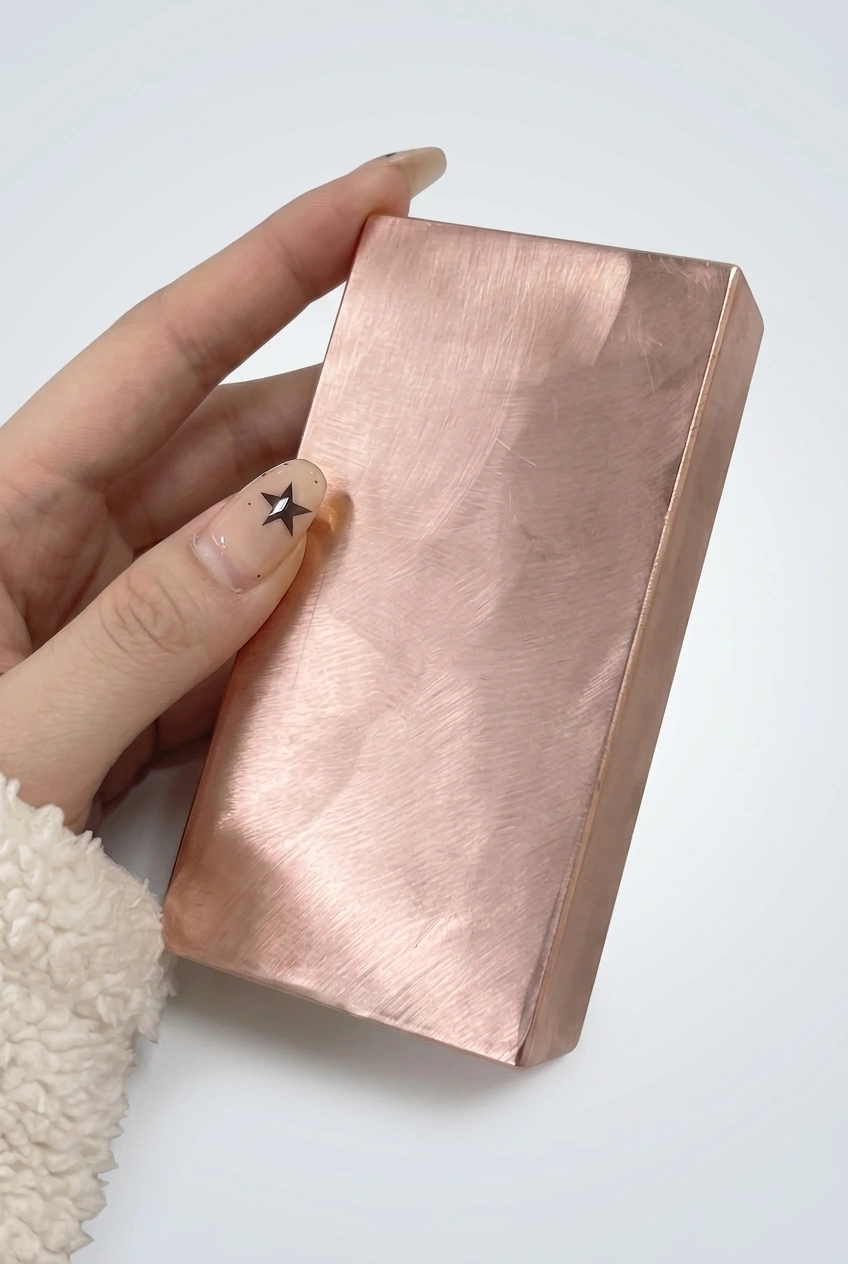
- Colour: pure copper has the characteristic warm, red-orange glow. Alloys drift toward yellow (brass) or brown (bronze).
- Conductivity: copper is second only to silver at conducting electricity and heat. Even small impurities lower conductivity noticeably — which is why C10100/C11000 is used in electronics.
- Weight and density: pure copper is dense (8.96 g/cm³), nearly like steel. A real 1 kg bar feels distinctly heavier than a copper-plated imitation of the same size.
- Ageing: pure copper forms an even, predictable patina over time. Alloys stain unevenly.
How is purity proven? XRF and the COA
A percentage printed in a listing is a claim, not proof. The industry standard for measuring metal purity is XRF — X-ray fluorescence. A calibrated XRF spectrometer bombards the surface with X-rays and reads the characteristic radiation each element emits back, producing an elemental profile down to the ppm level. The measurement is non-destructive: the bar is not damaged.
The result is documented in a certificate of authenticity (COA) that links the reading to the bar’s unique serial number. It is this chain — XRF reading, serial number and signed COA — that lets you actually prove what you own, today and at any future resale.
Oxidation and patina — is it a problem?
Pure copper reacts with oxygen and moisture and forms a patina over time — first a darker tone, then the familiar green coating (copper carbonate). It is purely cosmetic and does not affect the purity inside the bar. To preserve the mirror finish, keep the bar sealed and dry, ideally in a acrylic cover. It will then stay bright for decades.