Price and scrap
Copper price per kg in Norway, and what scrap yards pay
What copper is worth per kilo, what a scrap yard pays, and the rules for anyone delivering in Norway.
Copper trades on the London Metal Exchange (LME) in US dollars per tonne. Converted to Norwegian kroner, the metal value was about NOK 137 per kilo on 18 September 2026. That is not what you are paid for copper scrap. A scrap yard pays less, and how much less depends on what you bring. Here is the sum, the price level, where you can deliver, and the rules that apply in Norway.
How to work out today’s copper price per kg
You need two figures from the same day. The first is the copper price in dollars per tonne. Westmetall republishes the official LME prices every trading day, and you will also find them at the LME. The second is the dollar rate, which Norges Bank publishes daily. Multiply the price per tonne by the dollar rate and divide by 1,000. That gives the metal value in kroner per kilo.
| Date in 2026 | NOK per kg | LME, USD per tonne | Dollar rate |
|---|---|---|---|
| 2 January | about 127 | 12,571 | 10.07 |
| 19 March (low) | about 113 | 11,826 | 9.57 |
| 21 July | about 133 | 13,856 | 9.62 |
| 17 August (high) | about 140 | 14,850 | 9.42 |
| 18 September | about 137 | 14,529 | 9.43 |
In dollars, the copper price rose about 16 per cent from 2 January to 18 September 2026. In kroner the rise was about 8 per cent, because the dollar became cheaper over the same period. If you sell in Norway, both matter.
What do you get for copper scrap?
The scrap price is an offer from a buyer, and it sits below the metal value. The yard has to sort, process, transport and sell the metal on, and it carries the price risk in the meantime. Yards follow the LME and the dollar rate. Stokstad writes that prices follow the LME level and the krone against the dollar, and that a fixed price cannot be given before the scrap has been assessed. Norsk Gjenvinning points to the type of metal and how clean the material is. Keep your material clean and sorted and you are paid better. Both pages are in Norwegian.
NRK reported in July 2026 that the price of copper varies from NOK 60 to 120 per kilo, in a story about copper thefts. The metal value that day was about NOK 133 per kilo. By our conversion, the range was roughly 45 to 90 per cent of the metal value. Where you land in that range depends on quality, quantity and the yard.
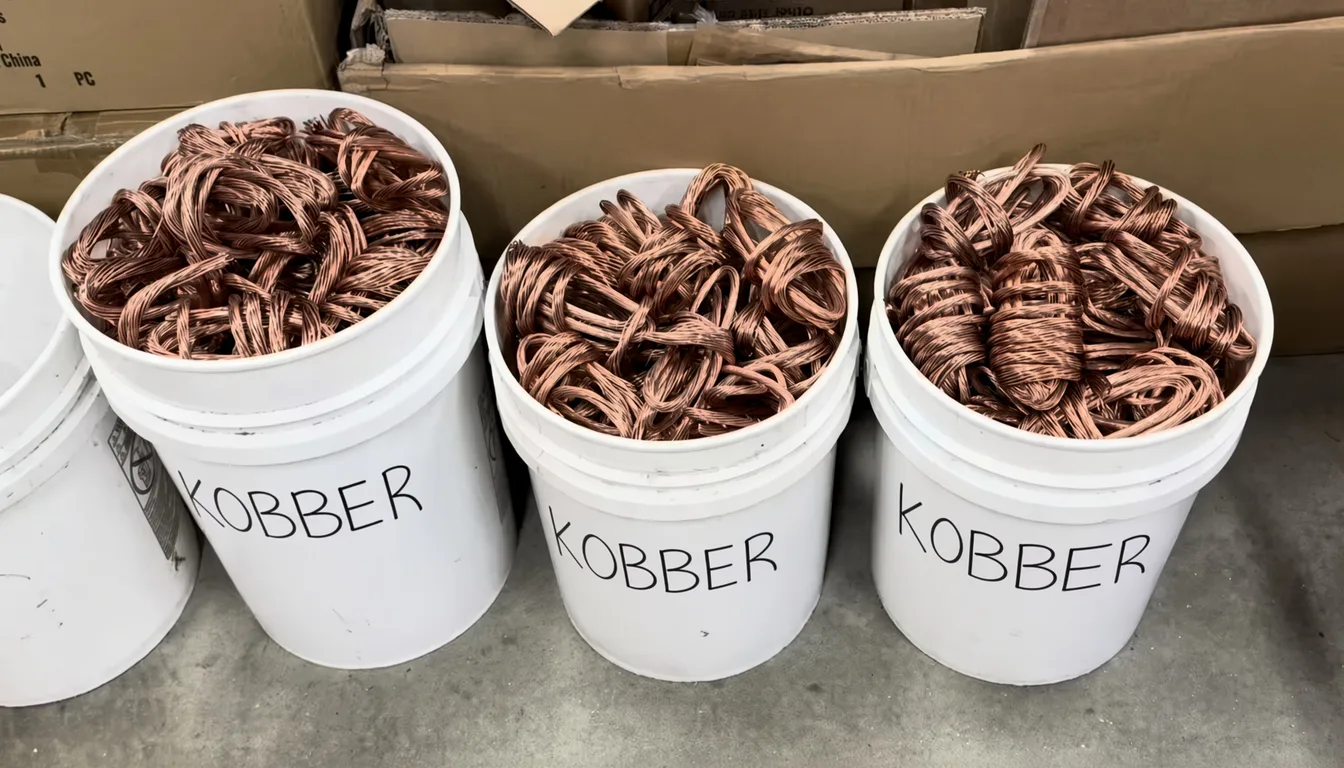
- Bright copper (blankt kobber): clean, uninsulated copper with no coating, solder or paint. Normally the best paid of all copper scrap.
- Copper pipe and mixed copper: pipes, sheet and gutters, often with solder, paint or verdigris. The yard deducts for contamination and for brass fittings.
- Insulated cable: copper conductor with plastic or rubber around it. Paid by copper content, so the price per kilo is far lower.
- Brass and bronze (messing, bronse): alloys of copper with zinc or tin. A category of their own, priced below clean copper.
- Motors and transformers: copper windings built into iron. A category of their own with a low price per kilo.
Categories and names vary between yards. Ask for a price per category before you deliver.
How much copper is in pipe and cable?
Copper weighs 8.96 grams per cubic centimetre, so you can estimate the weight before you drive to the yard.
- Copper pipe 15 × 1.0 mm: about 0.39 kg per metre.
- Copper pipe 22 × 1.0 mm: about 0.59 kg per metre.
- Earthing conductor 50 mm²: about 0.45 kg per metre.
- Installation cable 3 × 2.5 mm²: about 0.07 kg of copper per metre. The rest is insulation.
The figures are calculated from cross-section and density. Actual weight varies a little with the product.
Who buys copper, and where can you deliver?
Metal recyclers buy copper. Norsk Gjenvinning also pays private individuals for scrap metal. Other recyclers include Stena Recycling and regional yards such as Norscrap West and Stokstad. Not all of them accept deliveries from private individuals, so check before you go. Municipal recycling stations take metal too, but as Senja Avfall puts it, then you are not the one who earns from it.
At Norsk Gjenvinning you drive in, the material is weighed and registered, and the payment is transferred to your bank account. There has to be a certain quantity before you are paid, and the threshold depends on the metal. Other yards may work differently, so call first if you only have a little.
- Sort before you go. Bright copper, pipe, cable and brass are each priced separately.
- Remove what is not copper, such as fittings, brackets and insulation where that is practical.
- Ask for a price per category, and compare two yards if you can.
- Work out the metal value yourself first, so you know what the offer amounts to.
Coppervm sells new copper bars and does not buy scrap.
Which rules apply when you sell scrap metal?
Norway’s Second-hand Trade Act (brukthandellova) used to cover all trade in used and discarded goods. Since 1 July 2024 it only covers precious metals, gemstones and pearls, cultural objects, art, collectibles and antiques, and motor vehicles. That follows from Act no. 38 of 14 June 2024, which entered into force on 1 July 2024. Ordinary scrap metal such as copper is therefore outside that act.
The Penal Code applies regardless. Anyone who receives the proceeds of a criminal act can be punished for receiving stolen goods under section 332 with a fine or up to two years in prison, and negligent receiving is punishable under section 335. A yard that takes in stolen metal is taking a real risk. Norsk Gjenvinning writes that it has abolished cash payouts to counter illegal trade, and only pays to a bank account.
Online forums often mention a fixed limit of NOK 10,000 a year for private individuals. We have not found such a limit in law or at the Norwegian Tax Administration. Individual yards may have their own limits and requirements, so ask where you deliver.
Do you pay tax when you sell copper scrap?
Your own used belongings
A gain on the sale of household contents and other movables that have been used in your own home or household is exempt from tax under section 9-3 of the Taxation Act. With ordinary clearing out and renovation of your own home there is rarely a gain anyway. The scrap value is normally lower than what the materials cost.
Scrap from your job
Offcuts and leftovers from a job belong, as a starting point, to the employer or the customer. Norsk Gjenvinning requires a declaration form signed by the employer before it pays an employee privately. If you are allowed to keep the value, that is a benefit you received through your work, and such benefits are taxed as pay as a starting point. The Tax Administration applies a limit of NOK 5,000 a year for tax-free gifts from an employer, and the gift cannot be money. Whether scrap can count as such a gift is for the employer to assess and report.
When it becomes a business
If you collect and sell scrap systematically, it can become a business. The Tax Administration looks at whether the activity has a certain duration and scope, whether it is suited to making a profit, and whether it is run at your own expense and risk. The income is then taxable. If VAT-liable turnover passes NOK 50,000 within twelve months, the business must also be registered in the VAT Register.
Why do copper thefts rise with the price?
NRK counted nearly 30 copper thefts in Norway in a little over half a year in July 2026, twelve of them in Innlandet county. Five of eight timber bridges on the county roads there were hit, as was the railway. The scrap value of the copper on most of the bridges was only a few thousand kroner, but according to NRK the thefts have cost about six million. The county, the Public Roads Administration and Bane NOR are now switching to aluminium and galvanised steel.
That mismatch explains why the thefts hurt so much even when the haul is small. According to NRK, the police suspect the thefts are organised, and depend on tip-offs. Registration at the weighbridge, payment to a bank account and the rules on receiving stolen goods make it harder to sell stolen metal to serious yards.
What happens to the copper afterwards?
Copper scrap is remelted and refined into new metal. The International Copper Study Group describes copper as one of the few materials that do not lose their chemical or physical properties in recycling. That is why used copper keeps so much of its value, and why clean, sorted scrap is paid best. Read more about what drives the copper price and what pure copper is.