Background
Copper in the AI Age: Why Data Centres Devour Copper
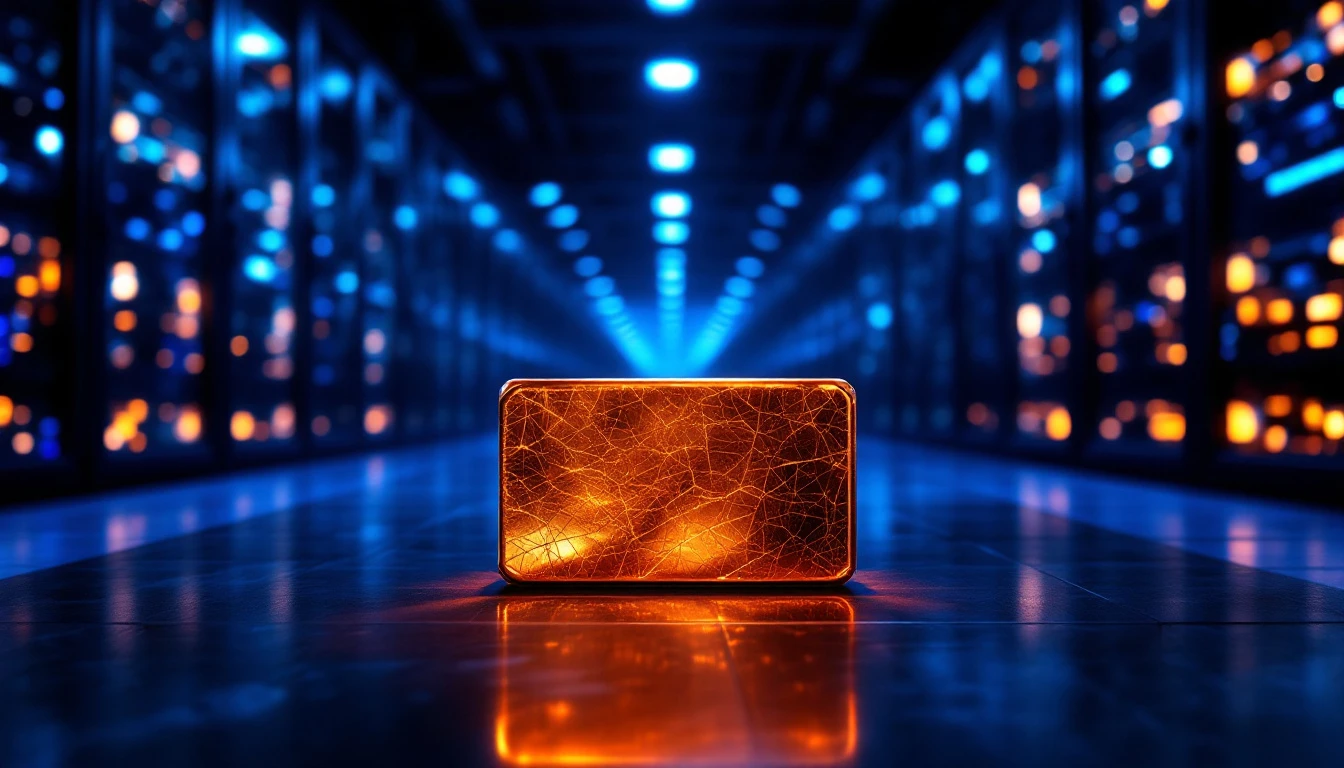
From chip to substation — the physical chain behind artificial intelligence.
Artificial intelligence feels weightless. You type a sentence, and an answer appears. But between the sentence and the answer lies one of the most material-intensive building periods in modern industrial history — and one metal recurs at every single step. Copper is not a detail in AI infrastructure. It is the precondition for the power reaching the chip at all, and for the heat getting back out.
From prompt to substation: the chain nobody sees
It is easy to picture a data centre as "servers in a room". Physically it is closer to a small power station in reverse: a building whose main job is to accept enormous quantities of electrical energy, convert them into computation, and shed the heat produced along the way. Each of those links is a copper problem.
- Inside the chip: microscopic copper interconnects carry signals between billions of transistors.
- Inside the rack: copper busbars and cables deliver power to every board.
- Around the rack: cold plates and piping move heat out of the hardware.
- Outside the building: transformers, high-voltage cables and new grid connections — the largest copper item of all.
What makes the AI wave distinctive is not that data centres are new. It is that power density jumped. A rack filled with accelerator cards draws many times what a previous-generation server rack did, and everything that carries current or heat had to be sized up accordingly.
Inside the chip: when aluminium lost to copper
The story begins somewhere few people think about copper: inside the microchip itself. Until the late 1990s, the microscopic wires between transistors were made of aluminium. In 1997 IBM introduced a manufacturing process using copper interconnects instead, and the rest of the industry followed.
The reason was twofold, and both halves are physics you cannot negotiate with. Copper has lower resistivity than aluminium — less resistance per conductor. And copper tolerates higher current density before electromigration sets in, the phenomenon where the current gradually displaces the metal atoms themselves until the conductor fails. As transistors grew smaller and denser, aluminium simply became the bottleneck.
It is the same property — conductivity — that makes copper interesting both in a chip and in a bar. Copper is the second-best conducting metal we know of, after silver, and the difference between pure and contaminated copper is measurable. We cover what purity actually means in what is pure copper? C10100, purity and XRF explained.
The power path: busbars, cabling and distribution
When power per rack rises sharply, you can no longer deliver current the way you used to. Thin cables run hot, and heat is both loss and risk. The solution in modern halls is massive copper busbars — flat copper bars acting as a motorway for current, with branches down to each individual rack.
- Busbars — solid copper bars carrying high current with low loss and predictable heat.
- Distribution units (PDUs) — copper in bars, contacts and internal conductors right up to the board.
- Backup power — UPS systems, battery banks and generators all hold substantial copper in windings and cabling.
- Earthing and protection — a copper earthing network is a safety-critical part of any large electrical installation.
The point is cumulative. No single component is dramatic, but a facility contains thousands of them, and every one carries current through copper.
Cooling: copper as a heat motorway
All energy entering a chip leaves again as heat. As power density climbs, air cooling eventually becomes insufficient, and the industry has moved to liquid cooling for the heaviest systems. Here copper reappears — this time for thermal conduction rather than electrical.
Copper conducts heat on the order of 400 watts per metre per kelvin, near-unbeatable among common engineering metals and roughly twice as well as aluminium. That is why the cold plates sitting directly on top of the chips are typically made of copper: they pull heat out of the silicon faster than any cheaper alternative.
Where the copper actually sits
| Link in the chain | Copper’s role | Why copper specifically |
|---|---|---|
| The microchip | Interconnects between transistors | Lower resistance and better electromigration resistance than aluminium |
| Boards and racks | PCB traces, contacts, internal cabling | Reliable conduction in very little space |
| Power distribution | Busbars, PDU bars, earthing | Carries high current with low loss and controlled heat |
| Liquid cooling | Cold plates and heat exchangers | Thermal conductivity near the top of all engineering metals |
| Backup power | Windings in UPS, generators, battery cabling | Handles sustained high load |
| Grid connection | Transformers, HV cables, substations | Industry standard for power transmission |
The biggest item is outside the building
Here is what surprises most people: the majority of the copper a data centre "consumes" is not inside the data centre. It is in the grid that must be built to feed it. A large facility needs a connection at a power level that often requires new or upgraded infrastructure — substations, high-voltage cables, switchgear and transformers, all carrying significant copper in their windings and conductors.
This is also where the timeline gets interesting. Servers can be installed in months. The grid connection takes years. That asymmetry — fast demand, slow physical infrastructure — is exactly the dynamic that characterises the copper market as a whole.
And AI is not alone in drawing on that same infrastructure. Transport electrification, renewable generation and the replacement of ageing grids all compete for the same supply chains. We looked at how those forces interact in copper price: what drives it — and how to read forecasts.
The metal in your hand is the same metal
There is something striking about the fact that the most advanced thing humans build — machines that write, reason and draw — rests on an element we have used for roughly ten thousand years. Copper was here before the Bronze Age got its name, and it still sits inside every chip running a language model.
That is also the whole idea behind a physical copper bar: holding the material itself, not a representation of it. Same element, same conductivity, same density of 8.96 g/cm³ — just in a form you can pick up. If you want to see how we document purity in our 1 kg bars, every one carries an XRF measurement, a serial number and a certificate.